There is a meeting that happens inside most large enterprises every few years. Someone from the content team sits across from someone from engineering and they have a variation of the same argument. The content team needs to move faster. Engineering has to protect the platform. Everyone leaves agreeing that things need to change, and then very little changes.
For most of the last two decades, Adobe Experience Manager sat at the center of that argument. It was the system that made powerful things possible and made simple things complicated. Understanding how AEM evolved from its current cloud architecture through Edge Delivery Services and toward an agentic content model is really a story about how that argument finally started to get resolved.
AEM as a Cloud Service: Moving the Infrastructure Without Moving the Model
By 2020, running AEM on-premise started to become painful for some large enterprises. Upgrades were year-long projects. Hardware provisioning was a bottleneck. Security patches required coordinated freezes. The operational burden was high.
AEM as a Cloud Service (AEMasCS), which Adobe launched as the fully managed cloud-native iteration of AEM, solved the infrastructure problem directly. The platform moved to a containerized, microservices-based architecture running on Adobe’s managed cloud. Auto-scaling meant you were no longer guessing at capacity before peak seasons. Auto-updates meant the upgrade nightmare largely disappeared. The operational team could stop worrying about whether the platform would survive traffic spikes and start thinking about what to build on top of it.
This was a real improvement. If you have ever been the architect on call at 2 a.m. during a deployment that went sideways on a self-managed AEM environment, the shift to AEMaaCS felt like a genuine release of pressure that you were waiting for.
But there was a constraint baked into the architecture that AEMaaCS did not address: the relationship between content authors and the development team.
The authoring model stayed largely intact. Content authors worked inside the AEM author environment. Templates, components, and content policies were controlled by developers (I know not in each case). When a content team in Singapore needed a new layout for a regional campaign, the workflow typically went: author identifies the need, raises a request, developer builds or extends a component, that component goes through testing and deployment, then the author finally gets to create the content they wanted to create.
What changed with AEMaaCS was where the platform ran. What did not change was who controlled the content loop. The infrastructure was modernized. The organizational dynamic was not.
This matters because for a Global 2000 enterprise operating in 30 markets with multiple language variants, the velocity constraint is rarely the CMS platform itself. It is the number of content changes that require a developer in the path. AEMasCS made the platform faster and cheaper to operate. It did not fundamentally change how fast a content team could move.
That required a different kind of architectural thinking.
Edge Delivery Services: Inverting Who Owns the Content Loop
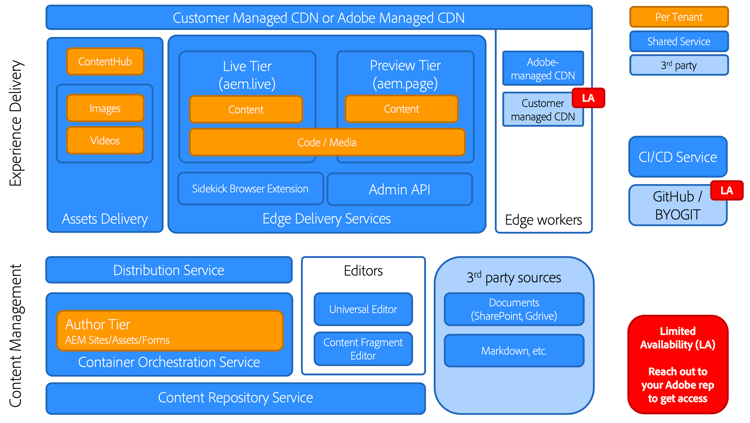
Image source: https://experienceleague.adobe.com/en/docs/experience-manager-cloud-service/content/edge-delivery/overview
The architectural model that Adobe introduced with Edge Delivery Services is sufficiently different from the traditional AEM model that it is worth slowing down to consider.
The traditional model is CMS-centric. Content lives in AEM’s content repository, authors work inside AEM’s authoring environment, and delivery is handled by AEM’s publish infrastructure with a CDN layer in front. The developer controls the system, and the author works within what the developer has built.
Edge Delivery Services inverts this. EDS is a delivery layer, not a CMS. It integrates with multiple content sources, and that flexibility is part of the design. Authors can work in Google Drive or Microsoft SharePoint, managing content as ordinary documents in tools they already know. For enterprises that want a more structured native option, Adobe has also built AEM Document Authoring, a purpose-built authoring environment designed specifically for EDS, with built-in versioning, bulk operations, localization workflows, and live preview. Developers define the site’s look and behavior once, in code stored on GitHub. After that, the content team can create and publish using whichever authoring tool the organization has standardized on, without touching AEM’s traditional authoring interface or the developer team.
For a content operations team managing multiple markets, this is significant. The campaign manager in Frankfurt who needs to update a product landing page can do it in a word document, in the tools they use for everything else, and the change is live in minutes. The developer is not in that loop at all.
The performance implications are also real. Because Edge Delivery Services renders content at the edge from lightweight document-based sources rather than making calls back to a central server, Google Lighthouse scores for sites built on EDS regularly hit 95+ across performance, accessibility, best practices, and SEO. For teams that have spent years managing Content Security Policy headers and JavaScript bundle sizes to keep AEM sites performant, those numbers… imagine their happiness.
This does not mean Edge Delivery Services replaces everything. Structured data management, product catalogs, personalization at depth, workflow-driven content processes: these still live most naturally in AEM’s content repository. What Adobe has done with EDS is define a new edge for the architecture, one where the authoring experience is radically simpler, the delivery is radically faster, and the developer’s role shifts from gatekeeper to enabler.
The technical pattern here is worth naming precisely. Edge Delivery Services represents what engineers sometimes call an architectural inversion. The prior architecture moved content from a central authoring system outward through a publish pipeline to an edge. The new architecture starts at the edge, with simple tools, and the complexity lives in the platform layer beneath, invisible to the author.
This is the setup for what comes next. You ready?
The Agentic Layer: When the CMS Starts Making Decisions
Adobe’s direction for AEM in 2026 is not simply about faster authoring or better performance. It is about introducing agentic capabilities into the content lifecycle. Understanding why this makes architectural sense requires seeing what the Edge Delivery Services model created.
When content is document-based, composable, and delivered from the edge through well-defined APIs, it becomes tractable for automated systems to work with. The content is no longer locked inside a proprietary repository that requires specialized tooling to access. It is structured, accessible, and interpretable.
Adobe has been building toward this explicitly across the last two Summit conferences. The Adobe Experience Platform Agent Orchestrator, announced at Summit 2025, is the coordination layer that lets businesses build, manage, and orchestrate AI agents across Adobe and third-party ecosystems. Summit 2026 expanded that foundation significantly, introducing Adobe CX Enterprise as the broader system, and adding three purpose-built agents directly into AEM Sites.
The Brand Experience Agent handles content production tasks: updating existing pages, creating net-new content, and modernizing legacy sites. The Content Advisor Agent surfaces approved content and prepares it for any channel. The Brand Governance Agent enforces brand policies, tracks asset rights, and manages permissions, ensuring content is always on-brand, authorized, and compliant. Separately, Adobe Brand Concierge extends the agentic layer outward to customers, delivering personalized conversational experiences on brand-owned digital properties, not as an authoring tool but as the customer-facing surface where the content that AEM manages gets activated.
What does agentic CMS behavior actually mean in practice?
Consider a global financial services firm running AEM with Edge Delivery Services across 15 regional sites. This could be your bank. An agent connected to the content layer could monitor performance signals from each page, identify underperforming content, generate alternatives using defined brand and compliance guidelines, route those alternatives through an approval workflow when the content touches regulated categories, and publish approved variants automatically when they do not. That loop, which today involves content strategists, copywriters, QA reviewers, and deployment engineers, can be orchestrated with human oversight at the decision points that require it, and automated where it does not.
This is not science fiction. The infrastructure for this exists today in pieces. AEM’s content API, the Edge Delivery Services delivery pipeline, Adobe Experience Platform’s real-time customer profile and decisioning, and the Agent Orchestrator as the coordination layer, with the Brand Governance Agent enforcing policy and the Brand Experience Agent handling production. What is being assembled is a connected system where the CMS is no longer just a repository with a publishing workflow. It is a participant in a larger automated content operation. You may want to look away and blink after reading this.
The architectural term for what this represents is important to understand correctly. An agentic system is not simply automation. Automation follows a fixed rule: if X, do Y. An agentic system observes context, makes decisions, takes actions, and adapts based on outcomes. The difference is the same one you see when you compare a scheduled batch job to a senior analyst who monitors a dashboard and decides what to do about what they see. One executes. The other reasons.
Applying that to content management means the CMS is no longer a passive store-and-serve system. It becomes a system that can reason about content performance, audience signals, brand consistency, and business goals, and act on that reasoning within defined boundaries.
What This Means If You Are Building the Architecture
For enterprise architects, the evolution from AEMasCS through Edge Delivery Services to agentic CMS capabilities presents a set of real decisions to make.
The first question is where to integrate EDS in the existing architecture. EDS and AEM are not mutually exclusive. The pattern Adobe recommends, and the one that makes architectural sense, is to use AEM’s repository for the content and data that genuinely benefits from structured management: product information, personalization segments, approval workflows, localization assets, etc. Use EDS for the surface area where speed and author accessibility are priorities: campaign pages, regional content, and frequently updated editorial pages. The two systems connect through APIs, and the Edge Delivery Services layer draws on AEM content where it needs to.
The second question is governance. When agents publish content, the governance model must be redesigned from the ground up. The traditional CMS governance model is workflow-based: a human approves before anything goes live. The agentic model requires policy-based governance: you define the rules (brand compliance, regulatory categories, quality thresholds) and the system enforces them, escalating to human review only when policy boundaries are reached or uncertainty is high. This is a meaningfully different architecture for the content operations team, and it requires collaboration among the content engineering team, legal and compliance, and the platform team to define the actual boundaries.
The third question is the skill profile of the teams you are building. The content engineer who succeeds in an agentic CMS world is not primarily someone who builds AEM components. They are someone who understands how to define content policies, how to instrument content for agent consumption, how to evaluate agent-generated content at scale, and how to build the oversight mechanisms that keep the system operating within boundaries. Some of those skills are already present in enterprise content teams today. Most do not, and building them is a real program of work.
The most important architectural insight is also the simplest one. AEMasCS solved the infrastructure problem. Edge Delivery Services solved the authoring velocity problem. The agentic layer is beginning to address the scale problem: the fundamental mismatch between the volume of content experiences a Global 2000 enterprise needs to deliver and the human capacity available to create and manage them.
Every prior generation of CMS technology expanded what was possible. This generation is beginning to change who, and what, can do the work.
The content team and the engineering team will still meet. They will probably still have arguments about velocity and control and who owns what. But the architecture is slowly shifting the terms of that argument. When agents can draft, test, and publish within guardrails, and when those guardrails are defined by policy rather than by developer availability, the question stops being “how do we get engineering to move faster” and starts being “how do we define the rules the system should operate by.”
That is a harder question in some ways. It is also more interesting.
For enterprise architects who have spent years mediating between content teams and development teams, that shift is probably overdue.
Please note: Views expressed here are my own and do not represent Adobe.